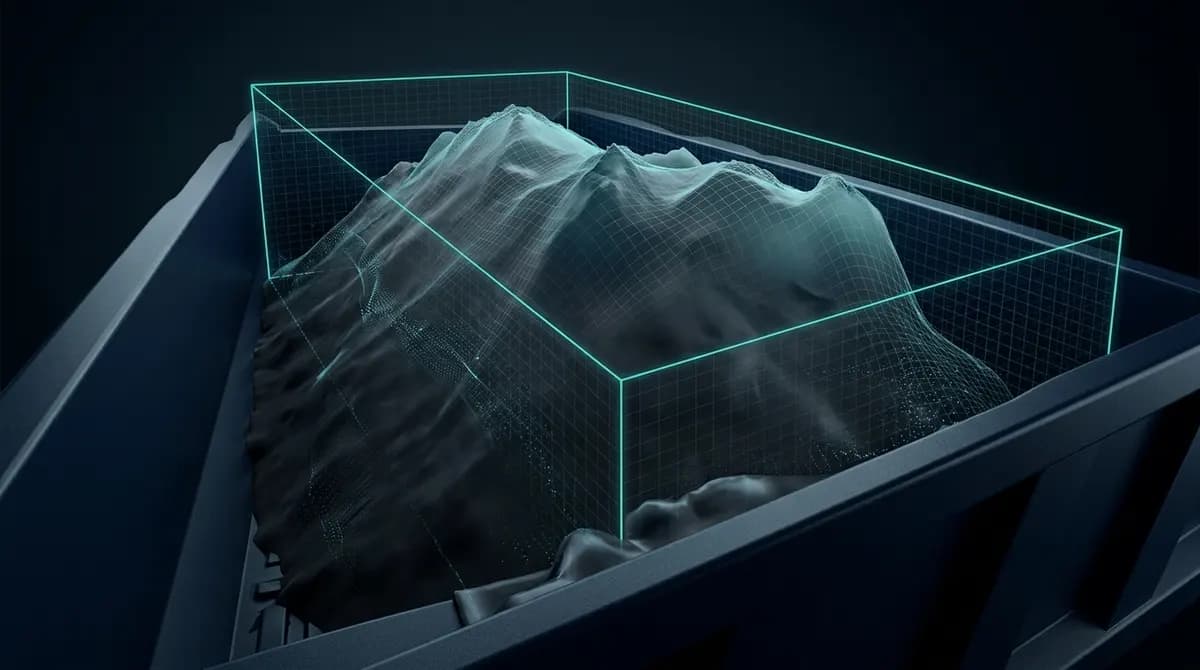
Computer vision estimates cargo volume in a dump-truck body by reconstructing the shape of the bulk-material surface from a camera image and computing the volume above the plane of the empty body. IQoko applies monocular computer vision — volume estimation from a single ordinary camera at a stationary or mobile control and measurement point (CMP) — for sand, gravel, soil and other bulk materials. This approach yields the actual volume of every trip with no manual measurement and no expensive laser frame, and the result is tied to the license plate and video into a verifiable digital trace of the trip — TripCode. This article explains how CV volume estimation works, what role LiDAR plays, how the method differs from laser scanners such as LoadScan and Walz, and why metrology under 102-FZ gives the data legal force.
Each section answers one specific question and reads on its own — you can start anywhere.
How computer vision estimates cargo volume in the body
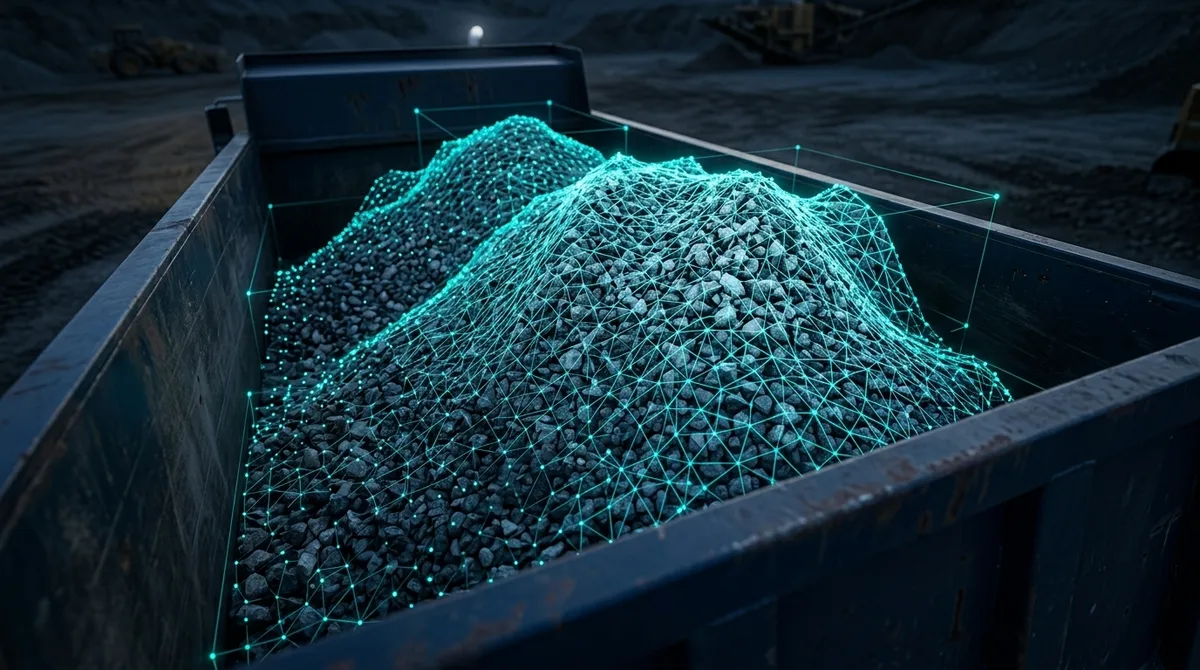
Computer vision estimates cargo volume by reconstructing the three-dimensional shape of the heap in the body from a two-dimensional image and integrating the material height over the area of the body. IQoko does this for dump trucks carrying bulk materials — sand, gravel, soil — at a stationary or mobile CMP on entry and exit. The algorithm determines the geometry of the body, builds a height map of the cargo surface relative to the plane of the empty body, and sums the volume above that plane; the output is cubic metres for the specific trip. This moves the question "how much material is in the body" out of the realm of manual eyeballing and trust in the driver and into the realm of a measurable quantity tied to a specific trip.
What "monocular" volume estimation from a single camera means
Monocular volume estimation is the computation of cargo volume from a single camera, without a second camera for a stereo pair and without a laser rangefinder. IQoko builds the approach as monocular (camera-first): volume is estimated from a single video stream of an ordinary IP camera at the CMP. Classic 3D reconstruction relies on stereo vision (two cameras with a known baseline) or on active depth sensors, whereas the monocular method recovers geometry from a single viewpoint — through scene calibration (known gate geometry and camera position) and models trained to predict the shape of the bulk-material surface. For the customer this means cheaper hardware and simpler installation: one camera instead of a laser frame or a stereo system, and therefore a lower barrier to entry on site.
Why LiDAR is needed if the camera does the counting
LiDAR in IQoko is needed not for the measurement itself but as a reference that confirms the camera's accuracy; the system is camera-first and able to work without it. IQoko positions LiDAR honestly: it is a confirmation of accuracy (it removes the customer's doubts), not the basis of measurement and not a "mandatory laser frame". The LiDAR reference is added where the customer needs confirmed accuracy: a laser profile of the body provides a reference height map against which the CV estimate is verified and calibrated, so the base CMP configuration runs on a single camera and LiDAR is an option; IQoko's development vector is toward camera-only, which is cheaper and more resilient to sanction-driven restrictions on imported sensors. Importantly, this is the opposite of the laser-scanner approach, where LiDAR is the measuring instrument itself; with IQoko the camera measures and LiDAR proves.
How CV estimation differs from laser volume scanners (LoadScan, Walz)
IQoko's CV estimation differs from laser volume scanners in that it measures volume with an ordinary camera rather than a laser frame that costs as much as a separate piece of capital equipment. Laser volumetric scanners — LoadScan (New Zealand, drive-through on a dual 2D-LiDAR, 700+ installations), Walz Scale (USA, 3D laser + AI, NTEP legal-for-trade), LASE (Germany, 3D laser gate) — are the industry benchmark for accuracy, but they are expensive laser infrastructure that in Russia means imports, a currency-denominated price, and sanction risks to supply and servicing. In addition, a laser scanner is a single measurement point: it gives cubic metres at the gate but does not tie them to the license plate, video and route in a single trip. IQoko closes both gaps: the monocular camera removes the expensive laser frame, while TripCode turns a one-off measurement into an end-to-end digital trace of loading → transport → unloading.
How CV volume estimation differs from scales and GPS tracking
CV volume estimation answers the question "how much material is in this body and of what kind", whereas scales give a single mass weighing at a single point, and GPS tracking gives only the vehicle's location. These are different layers of control for bulk-material haulage, and they are not interchangeable. Weight control records mass on entry or exit but does not cover loading and unloading and can be defeated by collusion or by driving around it; GPS telematics (Wialon, Omnicomm, Galileosky) shows the route but knows nothing about the contents of the body. CV volume estimation adds the missing parameter — the actual cargo volume of every trip — and so IQoko does not replace scales and telematics but builds on top of them, turning scattered signals into the evidentiary basis of TripCode.
Why monocular CV volume estimation is an open commercial niche
Monocular estimation of bulk-cargo volume from a single camera exists in research but is almost commercially vacant — a "blank spot" in which IQoko operates. The topic is explored in academic pilots: publications on monocular 3D reconstruction of bulk cargo and volume estimation (for example, work in ScienceDirect and MDPI Sensors), as well as individual projects such as ZebraX (Indonesia). Meanwhile, commercial products for measuring in-body volume rely on laser/LiDAR (LoadScan, Walz, LASE, Blickfeld), while adjacent CV players count not volume but buckets (Quarry Vision) or measure static stockpiles from photo/drone (Stockpile Reports, Propeller Aero). This means that the combination "monocular CV volume in a moving body + ANPR + video in a single trip" is commercially vacant — and it is precisely this that IQoko occupies.
How metrology under 102-FZ gives volume data legal force
Metrological certification of the measurement procedure under 102-FZ gives CV volume estimation legal force, without which cubic metres remain a reference figure rather than a basis for settlements. If the volume measured at the CMP is used for commercial settlement between a supplier and a recipient of bulk materials, Russian legislation on ensuring the uniformity of measurements (102-FZ) requires a certified measurement procedure. IQoko is preparing its CV volume-estimation procedure for metrological certification under 102-FZ — this simultaneously makes TripCode data suitable for disputes, acts and electronic transport documents and creates a barrier for competitors who have no certified procedure. The foreign analogue is legal-for-trade (NTEP) status for laser scanners; in Russia that role is filled precisely by certification under 102-FZ.
Why accurate per-trip volume matters: EPD and TripCode
Accurate per-trip volume matters because from 1 September 2026 electronic transport documents (EPD) become mandatory, and an electronic waybill is exactly as reliable as its source. From 1 September 2026 the mandatory transition to EPD begins (140-FZ of 7 June 2025), with data submitted to the state EPD information system through an accredited operator. If the volume in an EPD is entered manually, the electronic document is just as vulnerable as a paper waybill; IQoko's CV volume estimation provides a primary figure measured at the moment of the event and confirmed by video, which feeds into TripCode and onward — into the EPD and into the GosLog "digital transport passport". This is why volumetric CV estimation is not only loss control but also the foundation of reliable electronic source data under the 2026 regulation.
Where CV volume estimation works: stationary, mobile CMP, onboard
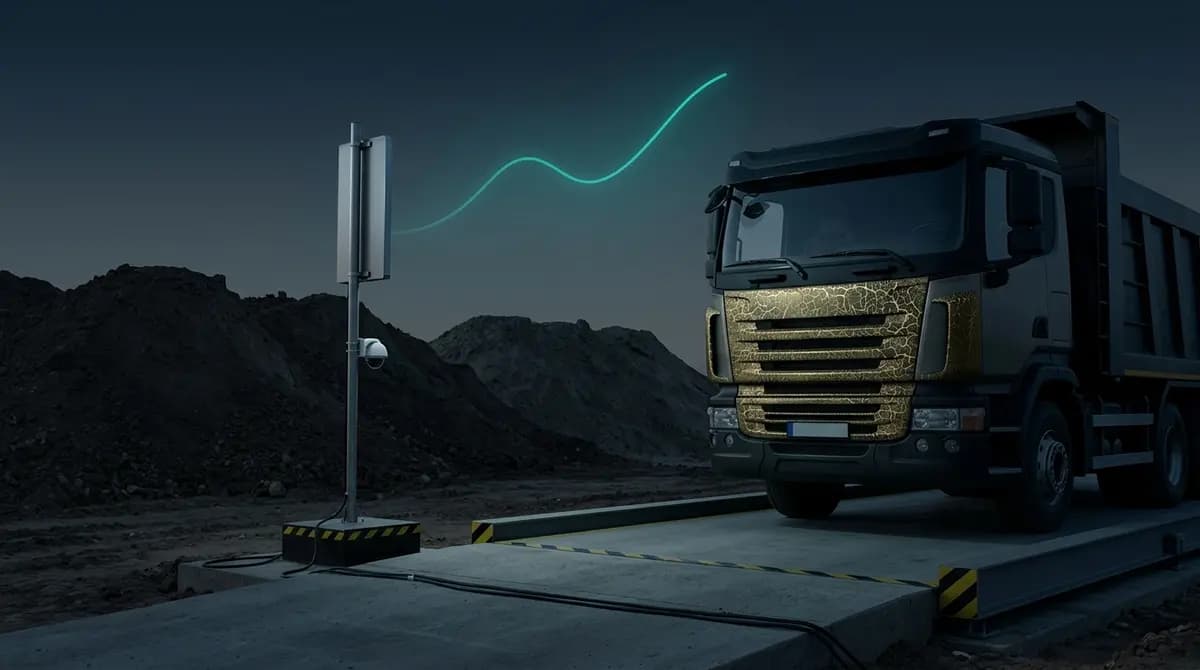
CV volume estimation works across three IQoko contours — stationary, mobile and onboard — so that volume is recorded at a permanent site, at a temporary construction site, and in the dump truck itself. IQoko Gate Pro is a stationary CMP with 2–4 cameras, ANPR, CV volume estimation and material classification; IQoko Mobile is an autonomous mobile CMP with a camera and CV for linear construction and temporary sites; IQoko Onboard is an onboard solution for dump-truck fleets. All contours bring data together into the cloud-based IQoko Platform, where the TripCode log is formed. This means that CV volume estimation is available where the customer previously had no objective measurement at all — for example, at a site without scales.
In brief: how computer vision estimates cargo volume
Computer vision estimates cargo volume by reconstructing the shape of the heap in the body from a camera image and integrating the height above the plane of the empty body, and IQoko does this monocularly — from a single ordinary camera. LiDAR in this scheme is a reference that confirms the camera's accuracy, not a measuring instrument, and the camera-first system is able to work without it. Unlike the LoadScan and Walz laser scanners, IQoko removes the expensive imported frame and ties volume to the license plate and video in an end-to-end TripCode, while metrological certification under 102-FZ gives this data legal force under the EPD mandatory from 1 September 2026. IQoko shows an accurate estimate tuned to the parameters of your site in a demonstration on your real trips.
Related articles
Trip proof for a dump-truck fleet: an onboard loop instead of a stationary measuring point
How a logistics contractor can prove a completed trip to a third-party customer and shut down off-the-books trips and fuel theft inside the fleet. IQoko Onboard travels with the truck across sites with no on-site infrastructure: tilt, load, fuel and GNSS as signals of an off-the-books trip, a digital trip act as the argument in a "his word against mine" dispute.
9 min
Read
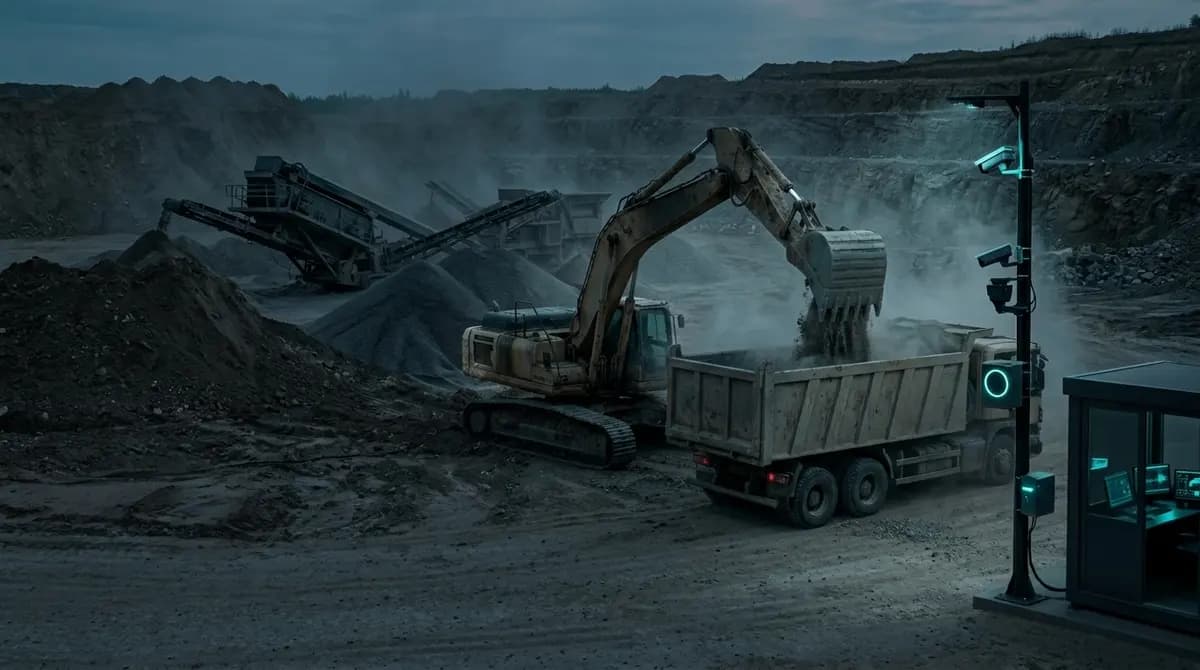
Bulk shipment control at a quarry: which CMP configuration to choose
A selection matrix for the CMP configuration to fit a quarry: when IQoko Gate is enough, when you need Gate Pro with CV volume estimation and scale integration, and how a 60–90 day pilot turns a loss hypothesis into a confirmed ROI. From the JTBD of three decision-makers — the CEO, security, and the CFO — to configuration criteria.
10 min
Read
Stationary CMP payback: how to calculate the trip-control recovery period
A step-by-step methodology for calculating the payback of a control-and-measurement station: the payback-period formula, what to attribute to CapEx and OpEx, how to factor in trip flow and the recoverable share of losses, and why a 60–90 day pilot measures that share before purchase. It turns the 5–15% loss range into a reproducible payback model for your site.
11 min
Read