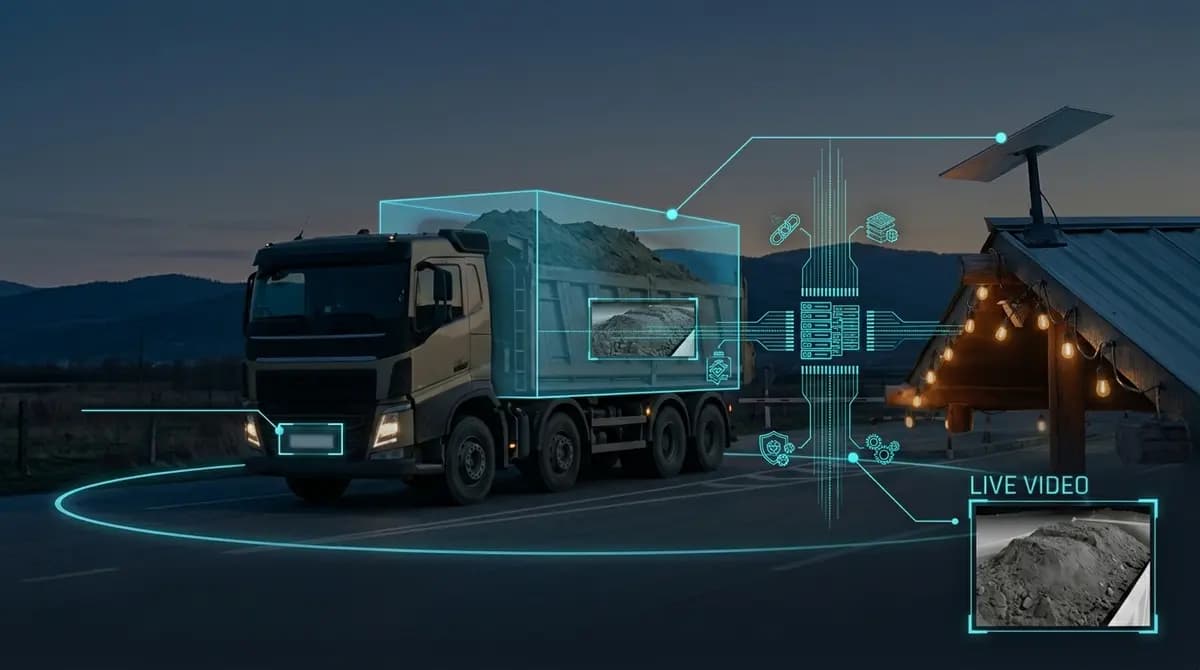
TripCode is the new standard of trip provability: a verifiable digital trail of a single bulk-material delivery, in which loading, transport and unloading are bound into one entity together with cargo volume, license plate and video. TripCode unites four independent signals about one trip — CV-based cargo volume estimation in the truck bed, license plate recognition (ANPR), video capture of the bed's state, and timestamps with geozones — into one object that cannot be credibly forged after the fact. IQoko introduces TripCode as the answer to the main problem of bulk-material transport: individual control tools — GPS tracking, scales, cameras — each capture a single parameter and are bypassed one at a time, whereas proving a trip requires that all signals converge simultaneously. This article explains what TripCode is, why it is practically impossible to forge, how it differs from telematics and weighing, and how it becomes the data source for EPD and GosLog.
Each section answers one specific question — you can read from any point.
CV volume
camera-based cargo volume
ANPR
license-plate recognition
Cargo video
recorded load state
Time & geofences
route, entry and exit
TripCode
one verifiable trip record
What TripCode is
TripCode is a verifiable digital trail of a single trip that binds loading, transport and unloading into one provable record. TripCode is formed on trips of bulk materials — sand, crushed stone, soil — and describes not a single point of the route but the whole trip as a single object. TripCode comprises four components: CV-based estimation of cargo volume in the dump truck bed via a monocular camera, license plate recognition through ANPR, video and photos of the bed's state, and timestamps and geozones of entry, exit and route. This yields, for every trip, one verifiable answer to the question "which vehicle, with what volume of which material, when and along which route delivered it" — instead of scattered lines in a tracker, at the weighbridge and in a video archive.
TripCode differs from the familiar notion of "control" in that it captures proof, not merely an event. Conventional telematics or weighing register a fact — the vehicle passed, the mass was recorded — but do not tie it to the physical cargo and do not make it fit for a dispute. TripCode attaches volume, license plate and video to one trip, so the record remains proof even a month later: in a dispute with a customer, during an internal audit, in an electronic waybill. IQoko calls TripCode an entity, not a report, precisely because it is the unit of provability on which accounting is built.
Why TripCode is practically impossible to forge
TripCode is practically impossible to forge because it consists of independent signals that would have to be falsified simultaneously and consistently. This is its main property and the reason TripCode is called a standard of provability rather than yet another control system. You can fake one figure in one system — "agree" on the mass at the weighbridge, drive around the checkpoint, manually enter the volume into the waybill. TripCode is built differently: cargo volume is estimated by computer vision from video, the license plate is recognized by ANPR, the bed's state is visible in the frames, and time and geozones are captured by telematics — and all four signals describe one trip.
The strength of TripCode is that falsification requires a simultaneous, non-contradictory substitution of all signals at once. To hide an underload it is not enough to amend the waybill: the video shows the real cargo level in the bed, the CV volume estimate gives an independent figure, and ANPR and timestamps tie all of it to a specific vehicle and moment. Any discrepancy between the signals itself becomes an alarm signal. That is why TripCode turns every underload, off-the-books trip and volume dispute from "one person's word against another's" into a verifiable event with an evidentiary basis.
How TripCode differs from telematics and weighing control
TripCode differs from telematics and weighing control in that it controls the whole trip and the physical cargo itself, not a single point and not a single parameter. This distinction is fundamental for companies that already have GPS tracking and scales but still suffer losses from opacity. Telematics — Wialon, Omnicomm, Galileosky — shows where the vehicle is but does not show what is in its bed and in what volume. Weighing control gives one weigh-in at one point, which can be bypassed by collusion, substitution or detour. TripCode closes the "black zone" between points: loading, transport and unloading are captured as a single object with volume, license plate and video.
TripCode does not replace telematics and weighing but makes them layers within the provable trail. GPS tracking remains the location layer: its geozones and timestamps become part of TripCode, tying volume and video to the route. The weighbridge, where it exists, remains one of the measurement points but stops being the only — and therefore vulnerable — number. For sites without scales, TripCode provides a CV-based volume estimate where previously there was no objective measurement at all. This is how IQoko builds control not instead of existing tools but on top of them — binding scattered data into one verifiable trip.
The key difference lies in the nature of the data. Telematics and weighing answer the questions "where is the vehicle" and "how much does it weigh at this point," while TripCode answers the question "what did this trip really deliver and can it be proven." It is precisely the answer to the last question that closes underload, theft, off-the-books trips and volume disputes — the sources of losses that, taken separately, neither the tracker, nor the scales, nor the camera catch.
How TripCode relates to EPD and GosLog
TripCode relates to EPD and GosLog as a source of verified primary data for the "digital transport passport." This connection makes TripCode not only a tool against losses but also an element of 2026 regulatory compliance. GosLog — the national digital transport and logistics platform (Government Decree No. 139 of 14 February 2026) — forms the digital transport passport, and TripCode serves as its source of data on volume, license plate and the fact of the trip, confirmed by video. The mandatory transition to electronic transport documents (EPD) under 140-FZ (of 7 June 2025) begins on 1 September 2026, with submission to the state system through an accredited operator.
TripCode solves the root problem of the electronic waybill — the trustworthiness of the source. An electronic waybill is exactly as trustworthy as its primary data: if the volume is entered manually, the EPD is just as forgeable as a paper one. TripCode provides unforgeable primary data — volume measured at the moment of the event and confirmed by video and ANPR — which becomes the source for the EPD and the GosLog digital passport. That is why deploying TripCode pays off twice: through reduced losses from opacity and through readiness for the mandatory EPD regulation from 1 September 2026.
For industries under separate oversight, the connection is even tighter. For the removal of construction waste, the OSSIG system requires the presence of a control and measurement point (CMP) that measures volume, logs entry/exit, recognizes license plates and records photos and video — and IQoko Gate Pro covers these requirements and forms a TripCode on every trip. Thus the provable trail of a trip turns out to be the common denominator for several state systems at once: OSSIG, GosLog and the GIS EPD.
What methodology TripCode's provability is built on
TripCode's provability is built on the Information Gain methodology — the principle by which each additional independent signal increases the trustworthiness of the trip and reduces the possibility of forgery. Information Gain is IQoko's original methodology, explaining why four bound signals deliver a qualitatively different result than the sum of four separate systems. By this logic, CV volume estimation, ANPR, video and telematics are not checks that duplicate one another but mutually confirming sources: each adds what the others lack and removes a class of doubt that the others do not close.
Information Gain explains why TripCode is impossible to forge precisely as a system, not as a set of functions. One signal can be disputed or faked; two signals about one trip must already not contradict each other; four independent signals together make a consistent falsification practically impossible, because substituting one immediately diverges from the rest. IQoko designs TripCode so that the gain in trustworthiness from binding the signals is maximal — this is the practical meaning of the Information Gain methodology.
The same logic gives TripCode legal weight. For the volume in TripCode to have force for commercial settlement, the measurement method undergoes metrological certification under 102-FZ, and LiDAR confirms the accuracy of the monocular camera as a reference standard. IQoko presents LiDAR honestly — as confirmation of the camera's accuracy, not as mandatory equipment: the system works camera-first and without it, while LiDAR removes doubts about accuracy. Thus the Information Gain methodology, 102-FZ metrology and LiDAR confirmation together turn TripCode from a convenient digital trail into an evidentiary basis you can rely on in a dispute, in court and in a state system.
What TripCode delivers in practice
In practice, TripCode turns every trip into proof suitable for internal control, for an external dispute and for regulatory reporting alike. For a quarry owner, TripCode makes underload, theft and off-the-books trips visible — sources of losses that the industry estimates at 5–15% of turnover. For logistics, TripCode reduces a trip to a single screen: volume, material, license plate, time, route and video in one record. For a general contractor, TripCode provides proof of the incoming volume at acceptance, settling the dispute over "how much was really delivered" in advance.
TripCode is the unit on which IQoko builds the entire digital control of bulk-material logistics. The IQoko slogan — "Every trip — proven" — describes exactly this property: a trip stops being a line in a waybill that must be taken on trust and becomes a verifiable event with volume, license plate and video. A precise calculation of the effect for the parameters of a specific site is available via the IQoko ROI calculator and a demonstration of TripCode on your real trips.
Related articles
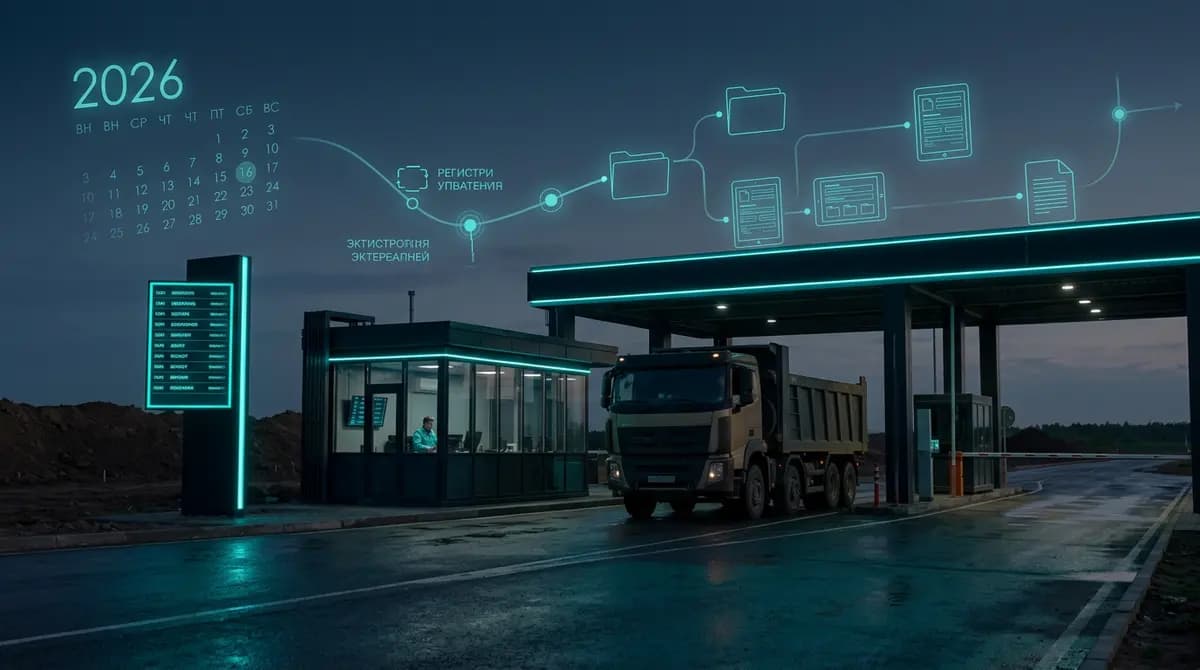
Freight Regulatory Calendar 2026-2027: GosLog, registries, mandatory EPD
A navigator calendar of carrier and quarry obligations: forwarders registry (~30 April 2026), GosLog launch (1 March 2026), mandatory EPD (1 September 2026), carriers registry (1 March 2027). For each rule — the deadline, what to do, and where TripCode provides tamper-proof primary data.
11 min
Read

Trip proof for a dump-truck fleet: an onboard loop instead of a stationary measuring point
How a logistics contractor can prove a completed trip to a third-party customer and shut down off-the-books trips and fuel theft inside the fleet. IQoko Onboard travels with the truck across sites with no on-site infrastructure: tilt, load, fuel and GNSS as signals of an off-the-books trip, a digital trip act as the argument in a "his word against mine" dispute.
9 min
Read

Bulk shipment control at a quarry: which CMP configuration to choose
A selection matrix for the CMP configuration to fit a quarry: when IQoko Gate is enough, when you need Gate Pro with CV volume estimation and scale integration, and how a 60–90 day pilot turns a loss hypothesis into a confirmed ROI. From the JTBD of three decision-makers — the CEO, security, and the CFO — to configuration criteria.
10 min
Read