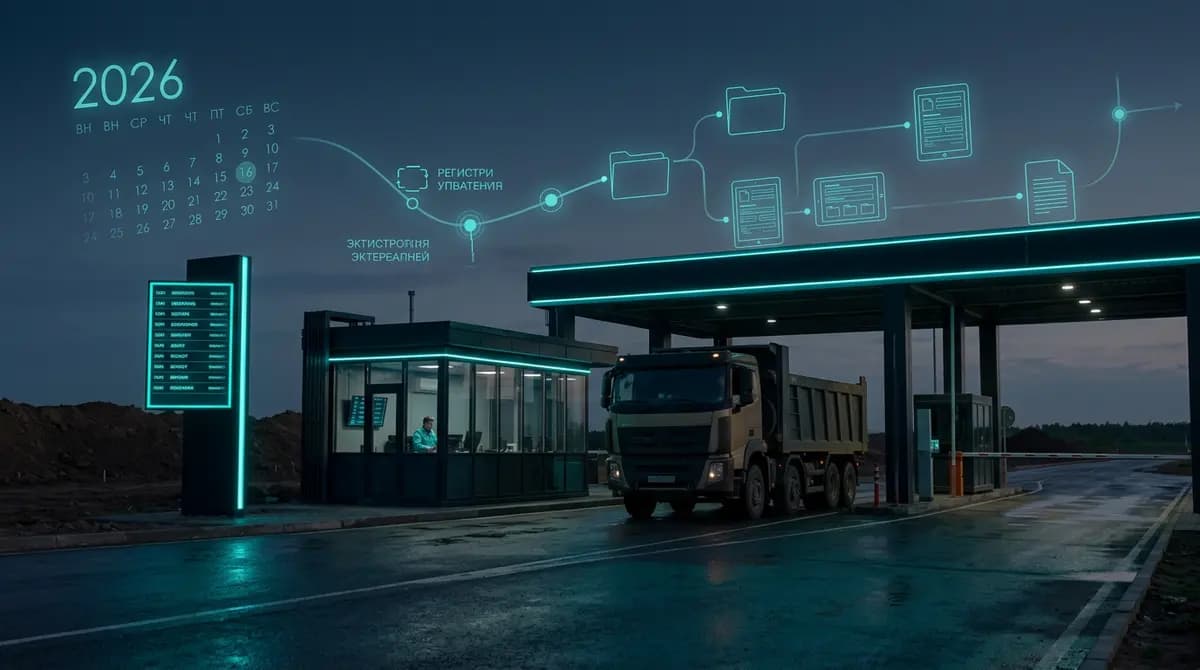
The freight regulatory calendar for 2026-2027 comes down to four key dates by which carriers and quarries must get their data and documents in order: the launch of the national GosLog platform (1 March 2026), the forwarders registry (roughly by 30 April 2026), the mandatory switch to electronic transport documents — EPD (1 September 2026), and the carriers registry (1 March 2027). These dates are constantly confused with one another because they belong to different rules — 140-FZ on EPD, Government Decree No. 139 on GosLog, amendments on industry registries — yet they fall almost back to back and affect one and the same carrier. This article lines them up into a single timeline and, for each rule, provides a frame of "obligation → deadline → action → where TripCode covers the primary data." IQoko treats the regulatory calendar not as a technology but as a set of deadlines: each one requires not just reporting, but trustworthy primary data — volume, license plate, the fact of the trip — that cannot be entered by hand.
Each section answers one specific question about one rule — you can start reading from any point.
Law on the switch to electronic waybills (EPD).
Start of the mandatory switch to EPD — the key date for carriers.
National “digital transport passport” platform and construction-waste control.
Why the dates of the freight regulatory calendar get confused with one another
The dates of the freight regulatory calendar get confused because four independent rules fall within a single year and are addressed to one carrier, yet they regulate different entities. GosLog is the national digital transport and logistics platform (Government Decree No. 139); EPD is the format for electronic transport documents (140-FZ); the forwarders and carriers registries are the market participants' admission to operate. A bulk-materials carrier hauling crushed stone from a quarry to a construction site falls under all four: it needs to be in the registry, submit EPD, transmit data to GosLog, and — for waste removal — also to OSSIG. That is why the regulatory calendar is not a single reform but an overlay of several, and the only way not to miss a deadline is to keep them in one timeline with distinct deadlines.
The regulatory calendar unites the rules by one property: they all require trustworthy primary data about the trip. EPD records the volume and the parties to the carriage, GosLog assembles a digital passport, the registries confirm a participant's good faith, and OSSIG requires volume measurement at a control and measurement point (CMP). In every case the weak link is the same — the source of the figure: if the volume is entered by hand, any electronic document is just as forgeable as a paper one. Here the regulatory calendar converges with the problem of losses: the link between trustworthy primary data and money is examined in detail in the article The cost of opacity in bulk-materials haulage, and the unit of evidence itself in the article TripCode — the new standard of trip evidence.
GosLog launch on 1 March 2026: what it is and what to prepare
GosLog launches on 1 March 2026 as the national digital transport and logistics platform, and by this date a carrier needs to understand what trip data it will transmit into it. GosLog is created under Government Decree No. 139 (dated 14 February 2026) as a state platform that aggregates freight data and forms a "digital carriage passport." For a bulk-materials carrier this means that the fact of the trip, the cargo volume, and the license plate cease to be the company's internal information and become data that a state system expects to see. Preparing for GosLog is not about buying separate software but about putting the source of trip data in order: the more trustworthy the primary data, the fewer discrepancies when transmitting to the platform.
The GosLog obligation: ensure that carriage data is fit for transmission into the digital passport. The deadline is 1 March 2026 (platform launch; the specific deadlines and the scope of mandatory data transmission are being clarified by secondary legislation for Government Decree No. 139). The action: determine where volume, license plate, and the fact of the trip come from, and make sure this data is captured automatically rather than filled in by a person. Where TripCode covers the primary data: TripCode produces the volume (CV estimate), the license plate (ANPR), video, and timestamps as a single trip, so it serves as a ready data source for the GosLog digital passport — without manual transfer of figures.
Forwarders registry (~30 April 2026): who it affects and what to do
The forwarders registry is introduced roughly by 30 April 2026 and requires transport-forwarding companies to be entered into a state registry in order to legally provide services. The forwarders registry is a market-admission measure: outside the registry, transport forwarding activity becomes impermissible, much as it is arranged for certain licensed types of activity. It primarily affects those who organize carriage using others' resources — forwarders and logistics intermediaries, through whom a significant share of bulk-materials haulage between quarry and construction site passes. For a quarry's own fleet the registry rule may be irrelevant, but if carriage is outsourced, a forwarder in the registry becomes a requirement for the counterparty.
The forwarders registry obligation: enter the registry (for a forwarder) or check the counterparty's presence in the registry (for the party ordering carriage). The deadline is roughly 30 April 2026 (details are being clarified by secondary legislation). The action: a forwarder files an application for entry; the customer adds a registry check to its contractor-selection procedure. Where TripCode covers the primary data: TripCode does not handle the registry entry itself, but it removes another forwarder risk — a dispute over the service actually rendered; TripCode records what volume of which material was actually carried on each trip, which protects the forwarder in a dispute with the principal and with the carrier.
Mandatory EPD from 1 September 2026: the key date for carriers
Electronic transport documents (EPD) have been mandatory since 1 September 2026, and this is the most significant date in the calendar for most carriers, because it affects every trip. EPD is made mandatory by 140-FZ (dated 7 June 2025): the electronic transport waybill (ETrN) and accompanying transport documents are issued electronically and transmitted to the state information system — GIS EPD — via an accredited operator. This applies equally to bulk-materials carriers, shippers, and consignees: the paper waybill ceases to be the primary document, and its place is taken by the ETrN with data submission to GIS EPD. In scale this is the most "high-frequency" rule: registries are handled once, whereas EPD accompanies every single carriage.
The EPD obligation: issue transport documents in the ETrN format and transmit them to GIS EPD via an operator. The effective date is 1 September 2026 (the mandatory transition has started; the staging and cargo categories are being clarified by secondary legislation). The action: connect to an accredited EDM/EPD operator and configure the data source for the waybill. Where TripCode covers the primary data: an EPD is trustworthy exactly to the extent that its source is trustworthy — if the volume in the ETrN is entered by hand, the electronic waybill is just as forgeable as a paper one. TripCode provides tamper-proof primary data: a volume measured from the actual trip and confirmed by video and ANPR, which goes into the ETrN as a verifiable figure. Why the accuracy of the volume in the waybill is critical and how it is measured without a laser frame is covered in the article How computer vision estimates cargo volume.
Carriers registry (1 March 2027): what changes six months after EPD
The carriers registry is introduced on 1 March 2027 and completes the admission framework: by this date a freight carrier must be in the state registry in order to legally perform carriage. The carriers registry is a measure symmetrical to the forwarders registry, but addressed directly to those who own transport and perform the carriage. It affects dump-truck fleets and any company that hauls bulk materials with its own transport for a fee; outside the registry, carriage activity becomes impermissible. The date 1 March 2027 sits six months after mandatory EPD, which is why it is especially often confused with the GosLog launch on 1 March 2026 — the day and month coincide, but not the year or the rule.
The carriers registry obligation: enter the registry (for a carrier) or check a carrier counterparty in the registry (for a customer and forwarder). The deadline is 1 March 2027 (details are being clarified by secondary legislation). The action: a carrier prepares documents in advance and files an application; the customer adds a carriers-registry check to its contractor-admission procedure. Where TripCode covers the primary data: the good-faith criteria for a registry participant typically rest on record-keeping discipline and the absence of violations; TripCode produces an audit trail for each trip — volume, license plate, video, route — which serves as the evidentiary basis for a carrier's good faith and removes claims over carriage actually performed.
How OSSIG ties the regulatory calendar to the control and measurement point
OSSIG ties the regulatory calendar to physical equipment on site: for the removal of construction waste, the OSSIG system requires a control and measurement point (CMP) that measures volume and records the trip. OSSIG is the industry accounting system for the handling of construction waste and soil, resting on dedicated regulation (including rules on waste and metrology — 102-FZ on ensuring the uniformity of measurements; the applicable rules depend on the region of the site). Unlike EPD and the registries, which regulate documents and admission, OSSIG sets a requirement for the measurement point: the CMP must measure volume, log entry and exit, recognize the license plate, and record photo and video. So for a carrier and a construction-waste generator, OSSIG is a rule not about paperwork but about equipment on the site.
The OSSIG obligation: provide on-site a CMP with volume measurement, entry/exit recording, license-plate recognition, and video capture. The deadline is set by industry and regional regulation of waste handling (details are being clarified by secondary legislation). The action: equip the site with a CMP that satisfies the system's requirements. Where TripCode covers the primary data: IQoko Gate Pro — a stationary CMP with cameras, ANPR, and CV volume estimation — covers the OSSIG requirements and produces a TripCode for every waste-removal trip. This way a single installation closes several lines of the calendar at once: OSSIG compliance, a source for EPD, and data for the GosLog digital passport. The metrological side — certification of the volume-measurement methodology under 102-FZ (metrological certification status is being clarified) — gives the TripCode figure legal force in accounting systems and disputes.
Why the trustworthiness of primary data is the common denominator of the entire calendar
The trustworthiness of primary trip data is the common denominator of all the rules in the 2026-2027 regulatory calendar: EPD, GosLog, the registries, and OSSIG record it differently but rest on the same source figures — volume, license plate, the fact and time of the trip. If these figures are filled in by hand, compliance becomes formal: the document exists, but it does not prove what is written in it. IQoko builds its approach around this bottleneck — not around an individual rule, but around a data source that alone serves the entire calendar. TripCode records the volume (CV estimate), the license plate (ANPR), video, and timestamps as a single verifiable trip, so the same primary data goes into the ETrN, into the GosLog digital passport, into OSSIG accounting, and into the evidentiary basis for the registries.
The regulatory calendar changes the economics of adopting digital control: what used to pay off only through loss reduction is now mandatory by law. Carriers and quarries are obliged to put their primary data in order by 2026-2027 anyway, and the only question is whether it will be a trustworthy automatic source or manual entry, vulnerable at the very first inspection. How to calculate CMP payback for your site's parameters is covered in the article CMP payback: how to calculate it. IQoko demonstrates a precise breakdown of the rules applicable to your site and a TripCode demo on your real trips on an individual basis.
Related articles

TripCode — the new standard of trip provability
TripCode is a verifiable digital trail of a trip: CV-based cargo volume estimation, ANPR, video and timestamps/geozones bound into a single trip. We break down what it is, why it is practically impossible to forge, how it differs from telematics and weighing, and how it becomes the data source for the GosLog digital transport passport and EPD.
9 min
Read

Trip proof for a dump-truck fleet: an onboard loop instead of a stationary measuring point
How a logistics contractor can prove a completed trip to a third-party customer and shut down off-the-books trips and fuel theft inside the fleet. IQoko Onboard travels with the truck across sites with no on-site infrastructure: tilt, load, fuel and GNSS as signals of an off-the-books trip, a digital trip act as the argument in a "his word against mine" dispute.
9 min
Read

Bulk shipment control at a quarry: which CMP configuration to choose
A selection matrix for the CMP configuration to fit a quarry: when IQoko Gate is enough, when you need Gate Pro with CV volume estimation and scale integration, and how a 60–90 day pilot turns a loss hypothesis into a confirmed ROI. From the JTBD of three decision-makers — the CEO, security, and the CFO — to configuration criteria.
10 min
Read