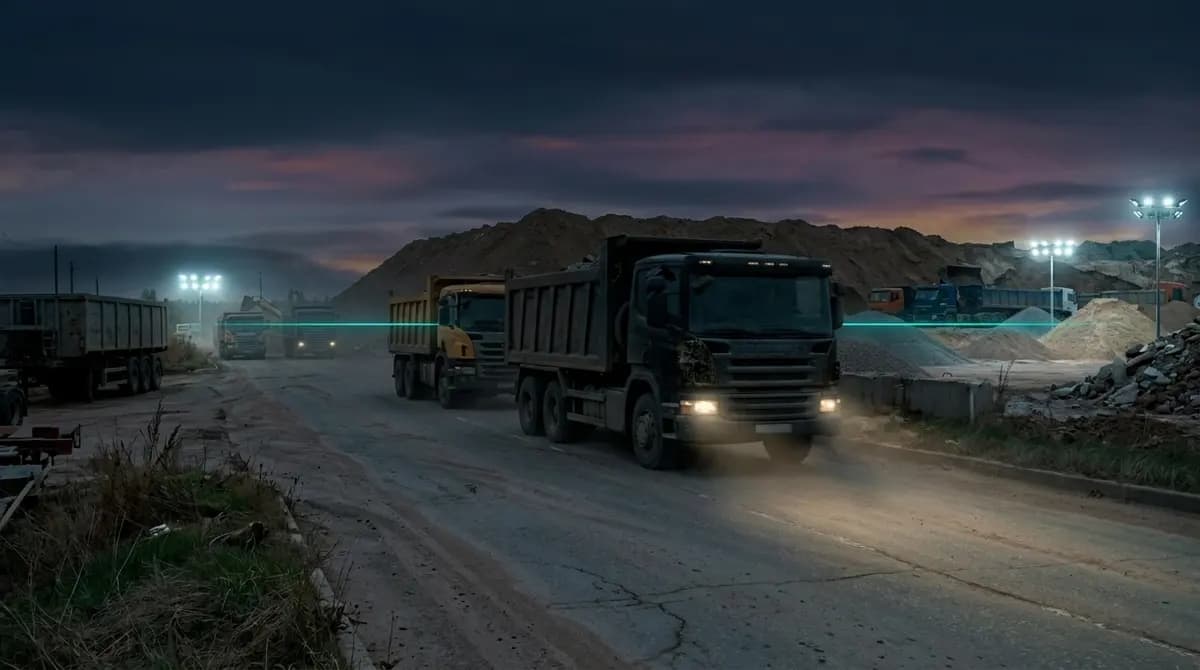
The cost of opacity in bulk-materials haulage is the 5–15% of turnover that a quarry or logistics company loses every year because it cannot see how much material actually left and how much actually arrived. By industry estimates, for haulage of bulk materials — sand, gravel, soil — losses from short-loading, theft and volume disputes amount to 5–15% of turnover. For a quarry with ₽500M in annual turnover that is ₽25–75M that vanishes without a single line in the books. IQoko treats this opacity as a measurable cost item and reduces it to zero through a verifiable digital trace of every trip — TripCode.
This article breaks down what makes up the cost of opacity, why the usual control tools fail to close it, and how to calculate losses at your own site. Each section answers one specific question — you can start reading from anywhere.
How much does opacity in bulk-materials haulage cost in money
Opacity in bulk-materials haulage costs 5–15% of turnover a year, and this figure can be calculated for a specific site. The estimate applies to quarries, transshipment yards and tipper-truck fleets where cargo volume is checked selectively or by hand. For a quarry with ₽500M in turnover the loss range is ₽25–75M a year; at an average trip value and a thousand trips a month this works out to tens of rubles of loss on every tonne hauled. The conclusion is simple: opacity is not "background noise of business" but the largest unaccounted cost item, comparable in scale to a quarry's profit.
What the losses are made of: the anatomy of opacity
Losses in bulk-materials haulage are made up of four recurring sources: short-loading, cargo theft, off-the-books trips and volume disputes. IQoko calls this structure the "anatomy of losses" because each source arises at its own point along the route and requires its own control. Below, each source is broken down — with its mechanics and the exact place where money leaves the quarry.
Short-loading: tonnes that were paid for but never received
Short-loading is the systematic shipment of a smaller volume than the documents state, and it is the most invisible source of losses. Short-loading happens on the bulk-materials supplier's side: a truck leaves with its body filled to 90–95% of nominal capacity, while the waybill is issued for the full volume. For a general contractor bringing 50,000 cubic metres of sand to a site, a 5% short-load is 2,500 cubic metres of paid-for "air". Short-loading cannot be caught without an objective assessment of the cargo volume in the body on every actual trip.
Cargo theft: dumping on the side and collusion at the weighbridge
Cargo theft is the removal of part of the material from legal circulation through dumping at an intermediate point or staff collusion at the weighbridge. Theft is typical of routes with a single control point: the driver passes the weighbridge with a full body, then unloads part of the cargo along the way. Collusion between the inspector and the driver at the weighbridge makes a single weighing unreliable, because the figure can be "agreed upon" and recorded. Theft is closed only by independent recording of the body's state across the entire route, not at a single point.
Off-the-books trips: the vehicle works, but not for you
An off-the-books trip is haulage performed on the company's equipment and fuel, but in someone else's interest and outside the books. Off-the-books trips arise in tipper-truck fleets where driver discipline is monitored by indirect indicators. A sign of an off-the-books trip is fuel consumption and engine hours that do not match the registered trips. An off-the-books trip is exposed by comparing actual load-and-unload events with the route: if a truck "was working" but there is not a single verified loading, the trip was off the books.
Volume disputes: who pays for the discrepancy
A volume dispute is a conflict between supplier and recipient over how much material was actually delivered, and by default it is paid for by whoever lacks proof. Disputes arise at acceptance by the general contractor or the customer, when the measurement at unloading diverges from the waybill. Without video evidence and a digital trip record, the one who shouts louder prevails over the one who shipped honestly. A volume dispute is closed in advance — by recording volume and video at loading and unloading, tied to a specific trip.
Why GPS tracking, scales and cameras on their own do not close the losses
Neither GPS tracking, nor scales, nor cameras on their own close the losses in bulk-materials haulage, because each tool controls only one parameter or one point. This is the key reason why companies that already have telematics and a weighbridge installed keep losing 5–15% of turnover. Let us examine the limitation of each tool separately.
GPS tracking shows where the truck is, but not what is in its body and in what volume. Telematics — Wialon, Omnicomm, Galileosky — records the route and geofences, and that is where its knowledge of the cargo ends. For bulk-materials haulage, where losses come from short-loading and theft rather than from route deviation, GPS tracking answers the wrong question. So telematics is needed, but as a location layer, not as cargo control.
Scales give one weighing at one point, which can be circumvented by collusion, substitution or a detour. Weight control records the mass at entry or exit, but does not cover the "black zone" between points — loading, transport and unloading. A single weighing is vulnerable: it can be "agreed upon" and recorded at the weighbridge, or bypassed if the site operates without scales. Scales close one point of the route, while losses arise along its entire length.
Cameras and video surveillance capture the picture, but without specialization on the body they give neither the cargo volume nor an evidentiary link to the trip. Video surveillance and ANPR systems — Trassir, Macroscop — recognize the license plate and store an archive, but do not answer the question "how much material is in this body". A video archive on its own is hours of footage in which the right moment is found by hand. A camera becomes a loss-control tool only when volume estimation runs on top of it and every frame is tied to a specific trip.
How IQoko turns opacity into a verifiable digital trace
IQoko closes all four sources of losses at once by combining cargo-volume estimation, license-plate recognition and end-to-end trip recording into a single entity — TripCode. TripCode is a verifiable digital trace of a trip, in which loading, transport and unloading are recorded as one object with volume, license plate and video. IQoko estimates the cargo volume in a tipper-truck body from a single camera using monocular computer vision, recognizes the license plate via ANPR and links the data into a TripCode that cannot be forged after the fact. This moves opacity out of the "unavoidable losses" category and into the controllable one: every short-load, every discrepancy and every off-the-books trip becomes a visible event.
Unlike point tools, IQoko controls the entire trip rather than a single point. Loading and unloading are recorded with volume estimation and video, the route is tied to these events, and TripCode makes the result usable for a dispute with the customer and for an electronic waybill. For sites without scales, IQoko provides a CV volume estimate where previously there was no objective measurement at all. This is how opacity that cost 5–15% of turnover turns into an evidentiary base on which accounting is built.
Why control over opacity became urgent in 2026
Control over opacity in bulk-materials haulage has turned from "good practice" into a regulatory requirement by 2026, and this changes the economics of adoption. From 1 September 2026 the mandatory transition to electronic transport documents (EPD) begins (140-FZ of 7 June 2025), with data transmitted to the state system. An electronic waybill is exactly as reliable as its source: if the volume is entered by hand, the EPD is just as forgeable as a paper waybill. IQoko provides unforgeable primary data — volume measured at the moment of the event and confirmed by video — which becomes the source for the EPD, so the fight against opacity now pays off twice: through reduced losses and through readiness for the new regulation.
How to calculate the cost of opacity at your own site
The cost of opacity at a specific site is calculated by the formula "annual turnover × loss share", and it is worth starting with a conservative estimate of 5%. The calculation needs two numbers: annual turnover in bulk materials and a realistic loss share from the 5–15% range — higher for routes with a single control point, lower for sites with disciplined accounting. At ₽500M in turnover, even the lower bound of 5% is ₽25M a year, an order of magnitude above the cost of digital trip control. A precise calculation tailored to your site's parameters is available via the IQoko ROI calculator and a demonstration on your real trips.
Related articles
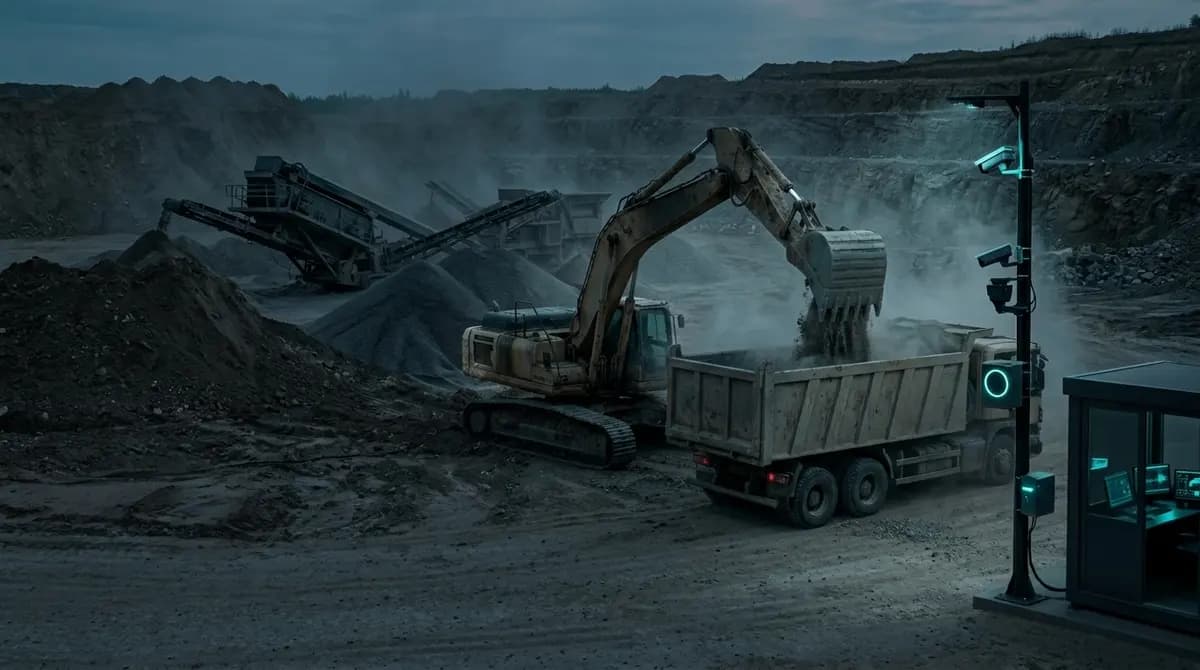
Bulk shipment control at a quarry: which CMP configuration to choose
A selection matrix for the CMP configuration to fit a quarry: when IQoko Gate is enough, when you need Gate Pro with CV volume estimation and scale integration, and how a 60–90 day pilot turns a loss hypothesis into a confirmed ROI. From the JTBD of three decision-makers — the CEO, security, and the CFO — to configuration criteria.
10 min
Read
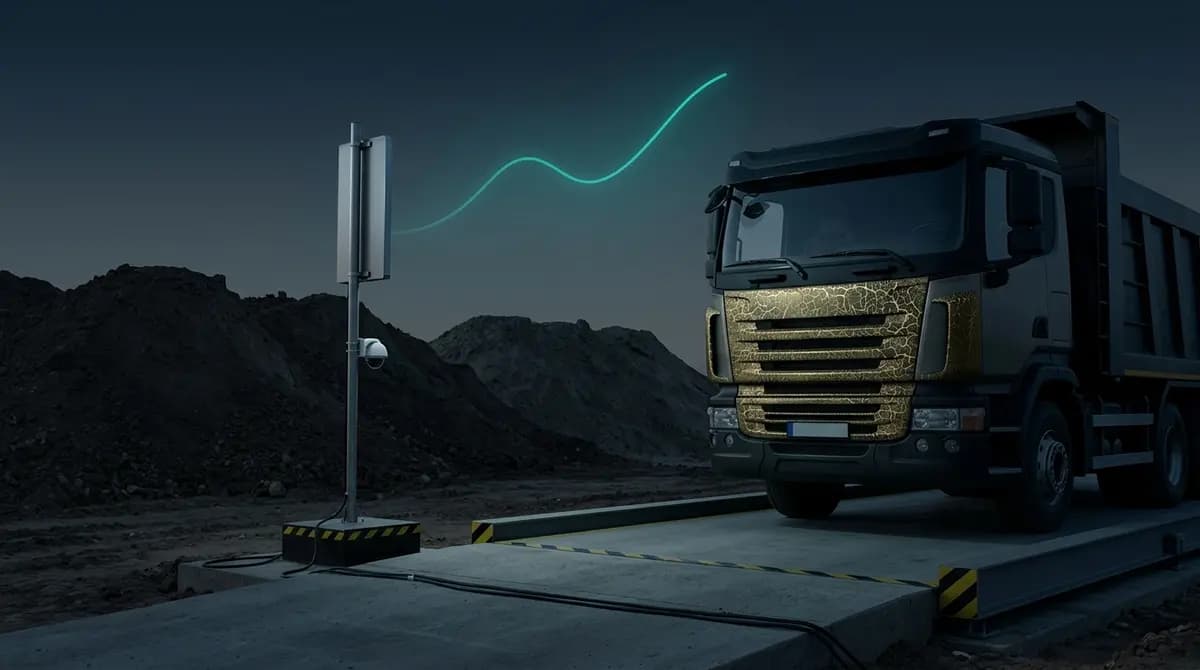
Stationary CMP payback: how to calculate the trip-control recovery period
A step-by-step methodology for calculating the payback of a control-and-measurement station: the payback-period formula, what to attribute to CapEx and OpEx, how to factor in trip flow and the recoverable share of losses, and why a 60–90 day pilot measures that share before purchase. It turns the 5–15% loss range into a reproducible payback model for your site.
11 min
Read
Trip proof for a dump-truck fleet: an onboard loop instead of a stationary measuring point
How a logistics contractor can prove a completed trip to a third-party customer and shut down off-the-books trips and fuel theft inside the fleet. IQoko Onboard travels with the truck across sites with no on-site infrastructure: tilt, load, fuel and GNSS as signals of an off-the-books trip, a digital trip act as the argument in a "his word against mine" dispute.
9 min
Read