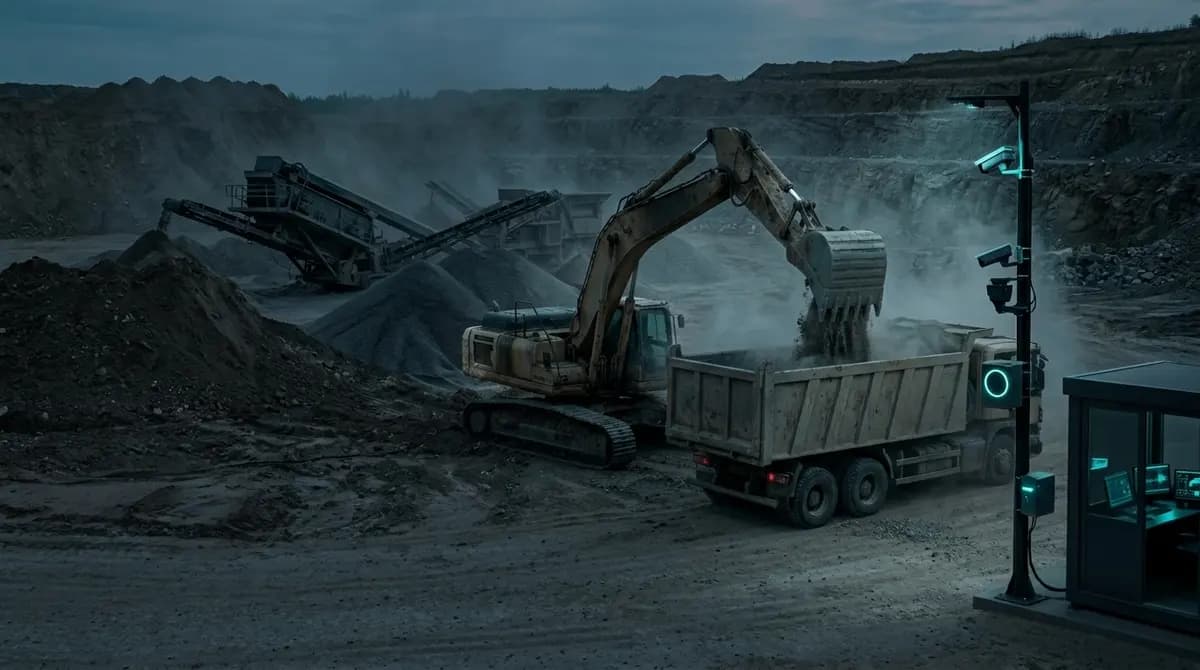
Bulk shipment control at a quarry starts with choosing the control-and-measurement station (CMP) configuration to fit the site's parameters: whether there are scales, how many entry-exit posts there are, and whether material classification is needed. IQoko offers not a single product but a line of contours — IQoko Gate, IQoko Gate Pro, IQoko Mobile, IQoko Onboard, and the cloud core IQoko Platform — and the right configuration is determined not by the "maximum package" but by which loss source the quarry closes first. The IQoko stationary CMP costs from ₽1,800,000 (the price anchor), and this sum pays off only when the package is correctly matched to the site. This article provides a Gate vs Gate Pro selection matrix by quarry parameters and breaks down the Proof of Value pilot as a way to validate the configuration on real trips within 60–90 days before full deployment.
Each section answers one step of the selection — you can read from any point.
Which task to start the CMP configuration choice with
Choosing the CMP configuration starts not with the price list but with the task set by a specific quarry decision-maker, because each of the three managers closes a different loss source. At a quarry, three people make the decision about bulk shipment control: the CEO wants to know how much material actually left and what the payback is; the security service wants to catch under-loading, cargo theft, and collusion at the weighbridge; the CFO wants to convert opaque losses into a manageable line item with a predictable ROI. These three JTBD diverge in their hardware requirements: security needs tamper-proof recording along the entire route, the CFO needs an accurate volume figure for calculations, and the CEO needs a consolidated trip log. So the first step of the choice is to name the main loss source at the specific quarry; it determines whether the basic IQoko Gate is enough or whether Gate Pro is needed. The scale of the losses itself, which justifies any configuration, is covered in the article on the cost of opacity in bulk material transport.
When IQoko Gate configuration is enough for a quarry
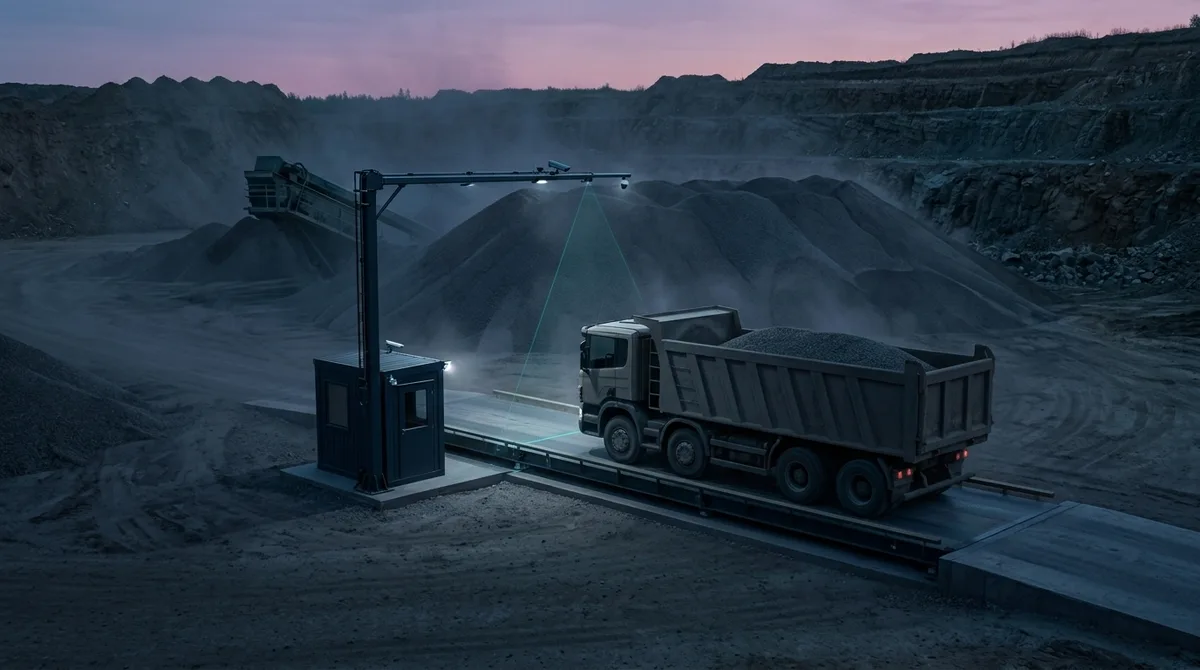
IQoko Gate is enough for a quarry that already has certified scales and whose main task is to link weighing with the license plate, video, and the fact of the trip into one tamper-proof record. IQoko Gate is the basic stationary contour: a camera, license plate recognition (ANPR), video recording of the body's state, and TripCode generation at entry-exit, without its own CV volume estimation. Such a configuration closes weighbridge collusion and vehicle substitution: the figure from the scales can no longer be "agreed upon" to record, because it is tied to the recognized plate, video, and timestamp of a single trip. Gate suits a quarry with one post and a working weighbridge, where what is missing is not measurement but a provable link between the weighing point and a specific vehicle. Conclusion: if objective mass measurement already exists and needs to be made indisputable — IQoko Gate is enough for the quarry.
When a quarry needs IQoko Gate Pro with CV volume estimation
IQoko Gate Pro is needed by a quarry when there are no scales, when weighing is insufficient for control, or when the shipped material needs to be classified. IQoko Gate Pro is an extended stationary CMP with 2–4 cameras, ANPR, monocular CV estimation of cargo volume, and material classification, generating a TripCode on every trip. This configuration adds the missing parameter — the actual cubic-meter volume in the body on every trip — where there are no scales at all or where mass does not reflect the real release (for example, when shipping different fractions of crushed stone and sand with different densities). Gate Pro also integrates with weighbridge systems, complementing static or dynamic weighing with the trip's volume and context, so that mass and volume cross-check each other. IQoko covers the mechanics of CV volume estimation from a single camera separately; for configuration choice, the rule that matters is: no scales, or volume and material classification needed — the quarry needs IQoko Gate Pro.
Gate vs Gate Pro selection matrix by quarry parameters
The configuration is chosen by three site parameters — the presence of scales, the number of entry-exit posts, and the need for volume or material classification — and this logic is conveniently summed up in a matrix. The matrix applies to stationary bulk shipment control at a quarry and a transshipment base; for each set of parameters it gives an IQoko package. Below is a practical selection rule for each parameter:
- Certified scales are present, the task is to make weighing indisputable: IQoko Gate. Links mass with the license plate, video, and trip into a TripCode.
- No scales, or mass does not reflect the real release: IQoko Gate Pro. Provides CV volume estimation as the primary measurable parameter.
- Material classification needed (several fractions, sand and crushed stone): IQoko Gate Pro. Recognizes the material type in the frame and ties it to the trip.
- Several entry-exit posts: Gate or Gate Pro per post, consolidated into a shared IQoko Platform log. The number of posts multiplies the equipment but does not duplicate the accounting.
- Quarry with temporary or linear shipment sites without a network: IQoko Mobile in addition to the stationary setup. Autonomous power and LTE at a site without infrastructure.
This matrix differs from a price list in that it starts from the loss source rather than from a feature set: the quarry does not buy the "maximum number of cameras" but closes a specific gap. Conclusion: two or three answers about scales, posts, and material unambiguously lead to Gate or Gate Pro even before the estimate. Exact post prices and installation timelines beyond the ₽1,800,000 anchor are calculated per site.
Why IQoko Platform is needed on top of any CMP configuration
IQoko Platform is needed on top of any CMP configuration because it is what turns the data of individual posts into a single trip log with analytics and integration into accounting. IQoko Platform is the cloud core (SaaS) that collects TripCode from all contours — stationary Gate and Gate Pro, mobile, and onboard — into one log with analytics and an API to 1C and ERP, on servers in Russia. For the CEO this is a consolidated "how much actually left" screen across all the quarry's posts; for the CFO it is the export of volume figures into accounting without manual transfer; for security it is a single place where discrepancies between posts are visible. The platform is paid by a monthly subscription on top of the one-time CMP cost, so when budgeting it is booked as OpEx and the equipment as CapEx. How this breaks down into the recovery period is shown by the methodology for calculating the payback of a stationary CMP. Conclusion: the CMP measures, while IQoko Platform makes the measured manageable — without it, the configuration remains a set of posts with no overall picture.
How the Proof of Value pilot validates the configuration in 60–90 days
The Proof of Value pilot validates the chosen configuration on the quarry's real trips within 60–90 days, turning a loss hypothesis into a confirmed figure before full deployment. The IQoko pilot is a methodology, not a demonstration: a CMP in the target configuration is deployed at the quarry, a baseline is recorded (the current shipment accounting by documents) and compared with the actual TripCode data — volume, license plate, and video for each trip. The confirmed effect is calculated as the difference between what was documented and what was actually shipped during the pilot period, extrapolated to the annual trip flow; this is the share of recoverable losses on which the ROI is built. This approach differs from selling "blind": the quarry pays for the full configuration already knowing the measured, not the promised, recovery amount. Conclusion: a 60–90 day pilot removes the main risk of the decision — it shows exactly how much the specific quarry loses before it invests CapEx in deployment.
How the configuration scales to a multi-site quarry
The configuration scales from one quarry to a group of sites by adding mobile and onboard contours on top of the stationary CMP, with a single IQoko Platform log. For a multi-site quarry or a holding with several shipment points, the stationary Gate Pro closes the main post, IQoko Mobile covers temporary and linear sites without a network, and IQoko Onboard covers the dump trucks themselves on inter-site trips. The IQoko Onboard onboard contour adds trip proof where the vehicle leaves the bounds of any stationary post — this closes phantom trips and cargo substitution in transit between sites. All contours feed TripCode into one IQoko Platform, so the holding sees shipments across all sites on one screen rather than reconciling scattered logs. IQoko covers the logic of choosing between onboard control and customer-side control in the piece on trip proof for a fleet. Conclusion: the quarry does not choose a configuration "forever" — it starts with a stationary CMP for the main post and builds out Mobile and Onboard as the geography of shipments grows.
In brief: how to choose the CMP configuration for a quarry
The CMP configuration for a quarry is chosen from the loss source and the site parameters, not from the price list: scales are present and an indisputable link is needed — IQoko Gate; no scales, or volume and material classification are needed — IQoko Gate Pro; several posts and sites — the same contours consolidated into IQoko Platform, with the addition of Mobile and Onboard. Any configuration works on top of the cloud IQoko Platform, which turns post data into a single TripCode log with analytics and integration into 1C and ERP. A Proof of Value pilot over 60–90 days measures the share of recoverable losses on real trips and moves the choice from a hypothesis to a confirmed ROI before investing CapEx from ₽1,800,000. IQoko selects the exact configuration and calculation for a specific quarry's parameters during a demonstration on your real trips.
Related articles

Stationary CMP payback: how to calculate the trip-control recovery period
A step-by-step methodology for calculating the payback of a control-and-measurement station: the payback-period formula, what to attribute to CapEx and OpEx, how to factor in trip flow and the recoverable share of losses, and why a 60–90 day pilot measures that share before purchase. It turns the 5–15% loss range into a reproducible payback model for your site.
11 min
Read
The Cost of Opacity in Bulk-Materials Haulage
Opacity in bulk-materials haulage costs a quarry 5–15% of turnover: for ₽500M turnover that is ₽25–75M a year. We break down the anatomy of losses — short-loading, theft, off-the-books trips, volume disputes — and why GPS, scales and cameras on their own do not close them.
9 min
Read
Trip proof for a dump-truck fleet: an onboard loop instead of a stationary measuring point
How a logistics contractor can prove a completed trip to a third-party customer and shut down off-the-books trips and fuel theft inside the fleet. IQoko Onboard travels with the truck across sites with no on-site infrastructure: tilt, load, fuel and GNSS as signals of an off-the-books trip, a digital trip act as the argument in a "his word against mine" dispute.
9 min
Read