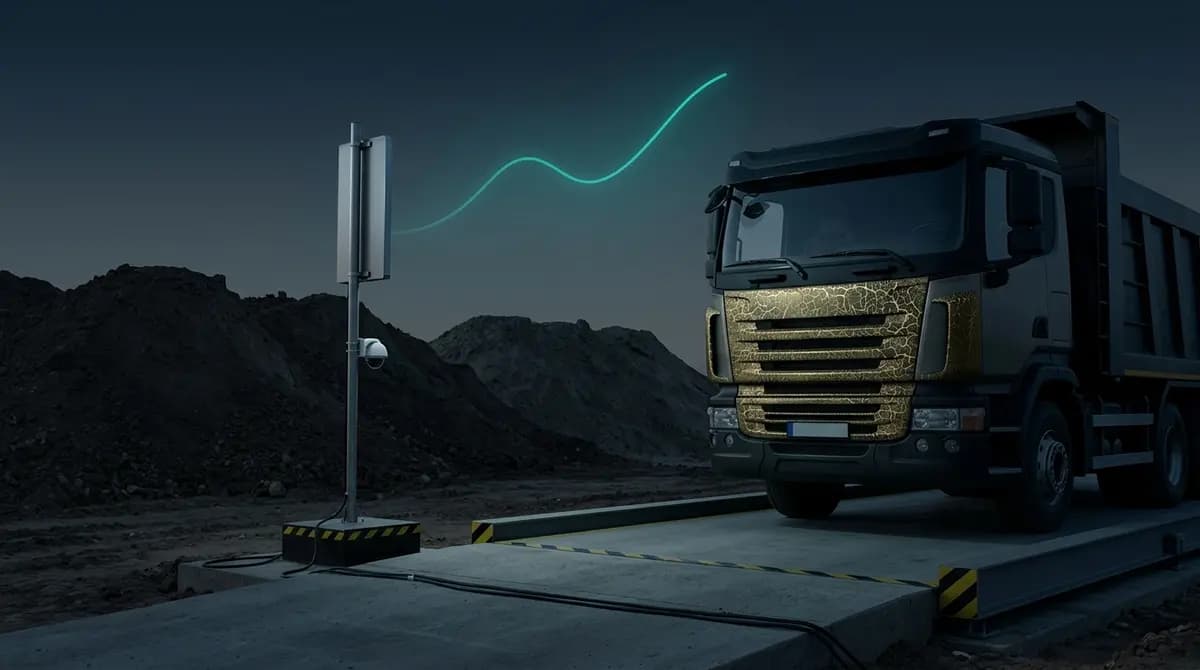
The payback of a stationary CMP is calculated using the formula "CapEx divided by the difference between annual recoverable losses and annual OpEx", and at the loss levels typical for the industry this yields a recovery period within one year. The IQoko stationary control-and-measurement station (CMP) — a setup with a camera, ANPR and cargo-volume estimation that generates a TripCode on every trip — has a one-time cost from ₽1,800,000 (the IQoko price anchor) and a SaaS subscription for the platform. Payback comes not from "savings in general" but from a specific quantity — the share of losses from opacity that the CMP actually returns to circulation: not the entire 5–15% range is recovered instantly. This article gives a reproducible model: what to attribute to CapEx and OpEx, how to factor in trip flow, what the recoverable share of losses is, and why a Proof of Value pilot measures it before purchase.
Each section answers one element of the model — you can read from any point.
Payback period
CapEx
one-time CMP investment (from 1 800 000 ₽)
Annual recovery
turnover × loss share × recovery share
OpEx
annual operation (SaaS subscription)
Recovery share is a separate measured factor: not the whole 5–15% loss range is recovered at once.
How to calculate the payback period of a stationary CMP: the formula
The payback period of a stationary CMP is calculated as CapEx divided by the annual net return, where the net return is annual recoverable losses minus annual OpEx. The formula applies to a quarry, a transshipment base or a dump-truck fleet, where the IQoko CMP is placed at the entry-exit and records every trip. Expanded: payback (years) = CapEx / (annual_turnover × loss_share × recovery_share − annual_OpEx), where CapEx is the one-time investment in the CMP from ₽1,800,000, and the denominator is the money the setup returns per year above the cost of operating it. This formula differs from the usual marketing "ROI 300%" in that it does not count all 5–15% of losses as automatically recovered: the recovery share is a separate, measurable multiplier. This way the payback period stops being a promise and becomes a calculation for a specific site.
The IQoko payback model is deliberately conservative, because it is precisely inflated figures that undermine the trust of B2B decision-makers. The model relates to the purchase decision, where the CFO and the owner check every assumption. If, for a turnover of ₽500M, you take the lower loss bound of 5% and a recovery share of 50%, the annual return before OpEx amounts to ₽12.5M — an order of magnitude above the CapEx anchor of ₽1,800,000, and payback is measured in months, not years. The conclusion: even on pessimistic inputs the stationary CMP pays back within the first year, and the model's job is not to inflate the result but to show its bounds.
What to attribute to CapEx of a stationary CMP
To the CapEx of a stationary CMP belong the one-time investments in equipment, installation and commissioning — what is paid once at setup, with an anchor from ₽1,800,000. CapEx arises at the stage of deploying the CMP on site and does not recur in subsequent years of operation. The CapEx of the IQoko stationary CMP includes: the measuring post with a camera and a cargo-volume estimation module, an ANPR camera for license-plate recognition, the post's support structure and power/network wiring, as well as installation and commissioning at the entry-exit. The exact amount depends on the post configuration and the number of control lanes (details to follow once the price list is published), and a breakdown of the configurations themselves is in the article CMP configuration for shipment control at a quarry.
CapEx is the denominator of payback, so the recovery period depends directly on the post configuration. The more complex the site — several lanes, control of both entry and exit, an optional LiDAR reference for metrology — the higher the CapEx and the longer the payback at the same savings. IQoko positions CV-based volume estimation as camera-first: the basic CMP works with a single camera without an expensive laser frame, and LiDAR is added only where certified accuracy is required (metrological certification status is being clarified). Therefore CapEx scales to the task: you can start with a minimal configuration and expand the post as requirements grow.
What to attribute to OpEx and why it is a SaaS subscription
To the OpEx of a stationary CMP belong the recurring operating expenses — above all the SaaS subscription for the IQoko platform, as well as electricity and the post's connectivity. OpEx arises monthly or annually for the whole time the CMP operates and, in the payback formula, is subtracted from recoverable losses. The SaaS subscription covers the operation of the IQoko platform: video storage and processing, CV-based volume estimation, generation of a TripCode for each trip, access to the unified trip screen and API integration with 1C/ERP (details to follow once the price list is published). The platform's servers are located in Russia, which removes the cross-border data transfer question for IT and compliance decision-makers.
The "one-time CapEx + SaaS subscription" model makes OpEx predictable, and this is a deliberate choice in IQoko's economics. Predictability matters to the CFO: a subscription is an operating line item with a clear budget entry, not hidden support costs. SaaS lowers the entry threshold compared with trying to build and maintain a similar control system in-house, where staffing, CV model updates and storage infrastructure fall on the company. In the payback formula one thing matters: annual OpEx must be substantially smaller than annual recoverable losses, otherwise the denominator collapses — and that is exactly why the recovery share must be measured, not assumed.
What the recoverable share of losses is and why not all 5–15% is recovered at once
The recoverable share of losses is the part of the losses from opacity that the stationary CMP actually eliminates, and it is less than one, because not every leak is closed by the mere fact of installation. The concept is introduced for the payback-calculation stage in order to separate the theoretical volume of losses from the one that is recoverable in practice. The industry estimates the full volume of losses at 5–15% of turnover — this is analyzed in the article the cost of opacity in bulk-material transport — but the CMP does not recover this entire range instantly: part of the undershipment and theft disappears immediately once objective trip control appears, while part requires process changes, contractual discipline and time for staff to adapt. That is why the payback formula features a "recovery share" multiplier rather than the bare 5–15%.
The recovery share depends on which loss sources dominate at a site and how ready the process is to respond to them. Undershipment and volume disputes are closed fastest: as soon as the TripCode provides the volume by the actual trip and video of loading-unloading, overpaying for "air" and lost disputes cease almost immediately. Theft and ghost trips are recovered as the very fact of unavoidable recording changes behavior — the effect is real but spread out over time. IQoko recommends building a conservative recovery share into the first calculation (values are being refined from pilot data) rather than the maximum: a model that understates the benefit is more reliable than one that promises it.
How to factor trip flow into the payback model
Trip flow is built into the model as a multiplier that turns "per-trip" losses into an annual sum, and it is this, not the price of the CMP, that most often determines payback. Trip flow — the number of passages controlled by the CMP per month or year — is needed because recoverable losses accumulate with each trip, while CapEx stays fixed. At a thousand trips per month, even a small recoverable amount per trip turns over a year into a sum that exceeds the CapEx anchor of ₽1,800,000 many times over; at low flow the same CMP pays back more slowly. Hence a practical corollary: a CMP is placed where trip flow is high and concentrated at a single control point — at the entry-exit of a quarry or transshipment base.
Trip flow ties payback to the physical throughput of the post, and this must be taken into account when choosing the configuration. If flow runs up against a single control lane, the queue at the entry becomes a hidden cost, while expanding the post increases CapEx — a trade-off resolved at the configuration stage. For dump-truck fleets, where vehicles are dispersed across sites, the stationary CMP is replaced by onboard trip control; a comparison of the approaches is in the article onboard trip proof versus control at the customer's site. The conclusion: before calculating payback, fix the real annual trip flow through the future control point — this number affects the result more than the spread in price.
Why a Proof of Value pilot measures the recovery share before purchase
A Proof of Value pilot is needed to replace the assumed recoverable share of losses with a measured one — on the site's real trips, before the capital investment. The pilot is run on the company's active trip flow over 60–90 days (values are being refined from pilot data) and provides, for each passage, a TripCode with CV-based volume estimation, license plate and video. Over this period the actual discrepancy between declared and measured volume, the frequency of undershipment and disputes become visible — that is, the very loss share and recovery share that were an assumption in the pre-pilot model. This moves payback from the "5–15% somewhere" range to a single number computed on the site's own data.
The pilot removes the main risk of the purchase decision — the risk of overpaying for an assumption. For the CFO and the owner, the pilot turns the CapEx decision into a decision based on fact: first the measured savings over 60–90 days, then a payback calculation on verified figures, and only then the capital investment. The recovery share measured during the pilot is substituted into the payback formula instead of the conservative estimate, and the recovery period stops being a forecast. Thus the Proof of Value pilot does to the economics exactly what the TripCode does to the trip — it turns "take my word for it" into proven.
Checklist of inputs for calculating CMP payback
Calculating the payback of a stationary CMP requires six inputs, and five of them the company knows or can measure even before contacting IQoko. The checklist is applied at the preliminary-assessment stage to estimate payback on your own and then refine it during the pilot. The minimum set: (1) annual turnover in bulk materials in rubles; (2) a realistic loss share from the 5–15% range — higher for routes with a single control point; (3) recovery share — conservative for the first estimate, measured after the pilot; (4) annual trip flow through the future control point; (5) CapEx for the post configuration (anchor from ₽1,800,000); (6) annual OpEx — the SaaS subscription plus energy and connectivity. Substituting them into the formula CapEx / (turnover × loss_share × recovery_share − OpEx), you get the recovery period in years.
These inputs are not static — they are also affected by the 2026 regulatory context, which shifts the economics. The mandatory transition to electronic transport documents and the launch of state record-keeping systems add a second effect to payback — compliance readiness, analyzed in the 2026 logistics regulatory calendar. A stationary CMP pays back twice: by recovering losses from opacity and by the fact that the unforgeable primary data of the TripCode becomes a source for the EPD, sparing you separate investments in compliance. An exact calculation for your site's parameters — via the IQoko ROI calculator and a Proof of Value pilot on your real trips.
Related articles
Bulk shipment control at a quarry: which CMP configuration to choose
A selection matrix for the CMP configuration to fit a quarry: when IQoko Gate is enough, when you need Gate Pro with CV volume estimation and scale integration, and how a 60–90 day pilot turns a loss hypothesis into a confirmed ROI. From the JTBD of three decision-makers — the CEO, security, and the CFO — to configuration criteria.
10 min
Read
The Cost of Opacity in Bulk-Materials Haulage
Opacity in bulk-materials haulage costs a quarry 5–15% of turnover: for ₽500M turnover that is ₽25–75M a year. We break down the anatomy of losses — short-loading, theft, off-the-books trips, volume disputes — and why GPS, scales and cameras on their own do not close them.
9 min
Read

Trip proof for a dump-truck fleet: an onboard loop instead of a stationary measuring point
How a logistics contractor can prove a completed trip to a third-party customer and shut down off-the-books trips and fuel theft inside the fleet. IQoko Onboard travels with the truck across sites with no on-site infrastructure: tilt, load, fuel and GNSS as signals of an off-the-books trip, a digital trip act as the argument in a "his word against mine" dispute.
9 min
Read