
Trip proof for a dump-truck fleet is a logistics company's ability to confirm to a third-party customer that a specific truck really hauled the declared volume along the declared route, while at the same time seeing off-the-books trips and fuel theft inside the fleet. For a contractor that hauls on other people's sites and does not control the loading point, a stationary control-and-measurement point (CMP) is useless: it sits at the customer's quarry, not in the dump truck's cab. IQoko Onboard moves the proof loop into the truck itself — an onboard controller with GNSS, cameras and sensors for tilt, load and fuel level (DUT) travels with the dump truck across any sites with no on-site infrastructure and assembles the trip into a verifiable digital trail — TripCode. This article explains how the onboard loop differs from the stationary one, how it builds on top of telematics that is already installed, and why "verified trip ↔ fuel ↔ engine hours" exposes an off-the-books trip.
Each section answers one specific contractor question — you can read from any point.

How the carrier-contractor's task differs from the quarry's task
A carrier-contractor solves the inverse task relative to a quarry: it needs to prove a trip to a third-party customer, whereas a quarry controls loading at its own point. A logistics company that owns a dump-truck fleet works on sites it does not own: loading happens at the customer's quarry, unloading happens at another customer's construction site, and the contractor has no control infrastructure of its own at these locations. Because of this, the stationary CMP IQoko Gate Pro, which covers loading control at the quarry, does not answer the contractor's question — it is tied to the gate of a specific site. A carrier needs control that travels with the truck rather than standing on someone else's site, so the basic unit of control for a fleet is not the gate but the truck.
How the onboard Onboard differs from the stationary Gate Pro
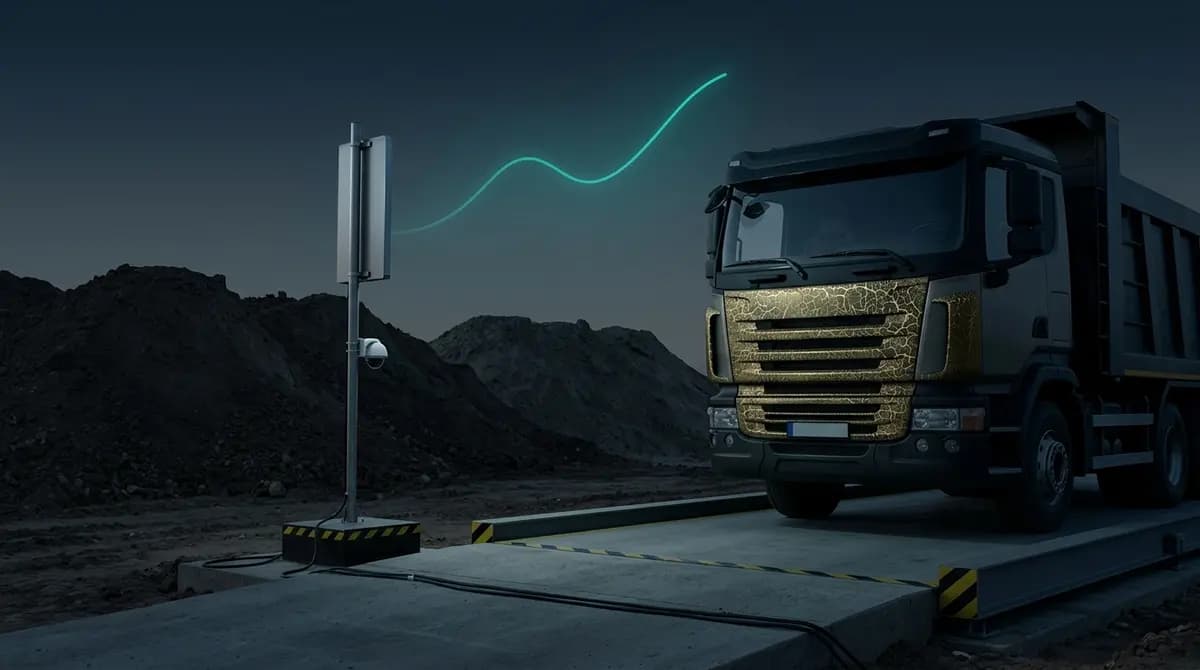
IQoko Onboard differs from Gate Pro in that it controls the truck along the entire route across any sites, while Gate Pro records the trip at a single stationary point. Gate Pro is a stationary CMP with cameras, ANPR and CV volume estimation, installed at the entry/exit of a permanent site and ideal for a quarry owner. IQoko Onboard is an onboard loop: a controller, GNSS and LTE, 1–2 cameras and sensors for fuel, tilt and load, mounted on the dump truck itself. The fundamental difference is in the set of signals: Gate Pro has no sensors for body tilt, axle load and fuel level, because it does not travel with the truck, while Onboard adds exactly those onboard signals that cannot be captured from a stationary point. For a contractor this means the evidence base is collected where the truck works, not where someone else's gate stands.
Which onboard signals reveal an off-the-books trip
An off-the-books trip is revealed by four onboard signals that fail to add up with one another: body tilt, axle load, fuel consumption by DUT and the GNSS track. An off-the-books trip is hauling on the company's equipment and fuel, but in someone else's interest and outside the books; inside a fleet it is the most expensive and the most invisible source of losses. IQoko Onboard catches it at the intersection of signals: the tilt sensor records the body being raised (the fact of unloading), the load sensor records the "loaded → empty" transition, DUT records real consumption, and GNSS records where and when it happened. If a dump truck raised its body and unloaded in a geozone that appears in no documented trip, or if fuel was spent and engine hours were run up while there is not a single verified loading — the trip was off the books. This is how Onboard turns an off-the-books trip from "a suspicion based on indirect signs" into a recorded event with coordinates and time.
How Onboard detects fuel theft inside the fleet
Onboard detects fuel theft by comparing DUT consumption with the transport work actually performed, rather than trusting a norm. Fuel theft is the diversion of fuel out of legal circulation, disguised in the reporting as consumption on trips; you cannot catch it by indirect norms, because a norm can always be "tuned" to fit. IQoko Onboard installs a fuel level sensor (DUT) and links its readings to the TripCode of every trip: you can see how much fuel went to confirmed loadings/unloadings and how much disappeared without transport work. A sharp drop in the DUT level while parked, with no movement and no trip, is the signature of theft; consumption not covered by any verified trip is either theft or an off-the-books trip. The contractor gets not "overconsumption in liters" but a link from every liter to a specific proven or unproven trip.
How Onboard builds on top of already-installed Wialon and Omnicomm telematics
IQoko Onboard builds on top of already-installed GPS telematics, adding cargo proof to location rather than replacing the tracker. Most fleets already have telematics — Wialon, Omnicomm, Galileosky — and it answers the question "where is the truck" but not the question "what did the truck actually haul, and can it be proven". IQoko Onboard takes the GNSS track as a location layer and completes it with CV volume estimation by camera, tilt, load and fuel, tying everything into TripCode — the same way TripCode turns disparate signals into an untamperable trip. This increases the value of the money already invested in telematics: the same fleet, the same geozone logic, but a trip is now not a string of coordinates but proof with volume and video. For the contractor's IT department this is an add-on over the existing stack, not a migration: telematics remains the location layer inside the proof trail.
Why "verified trip ↔ fuel ↔ engine hours" is the fleet's key correlation
The correlation "verified trip ↔ fuel ↔ engine hours" is the key fleet audit tool, because any gap in this trio is precisely a loss. The logic is simple and verifiable: every honest trip spends fuel and engine hours and leaves a verified loading/unloading in TripCode; if fuel was spent and engine hours accrued but there is no confirmed trip behind them — the work was not done for you. IQoko Platform brings together three values per truck and period: the sum of verified trips (by TripCode), DUT consumption and engine hours from the onboard controller. A truck whose engine hours and fuel grow faster than the sum of proven trips is a candidate for off-the-books trips or theft; a truck where the trio adds up is clean. This correlation turns disparate sensor readings into a single management question — "what did we pay for in fuel and resources but did not get a proven trip for".
How a digital trip act closes the "his word against mine" dispute with a customer
A digital trip act closes the dispute with a customer by turning "his word against mine" into a verifiable event with volume, route and video. In a volume dispute at acceptance, by default the party without proof loses: if the measurement at unloading diverges from the waybill, whoever is louder turns out to be right. IQoko Onboard generates a digital act for each trip based on TripCode — a CV volume estimate of the cargo, a GNSS track from loading to unloading, the fact of the body being raised at unloading, and video of the body's condition, tied into a single record. This gives the contractor an argument that cannot be disputed with emotion: not "we delivered it, honestly" but "here is the trip — volume, route, time, video". This is how trip proof works both ways: inward against the fleet's off-the-books trips and theft, and outward against the customer's unfounded claims over volume.
Why the freight forwarders register makes trip proof urgent for the contractor
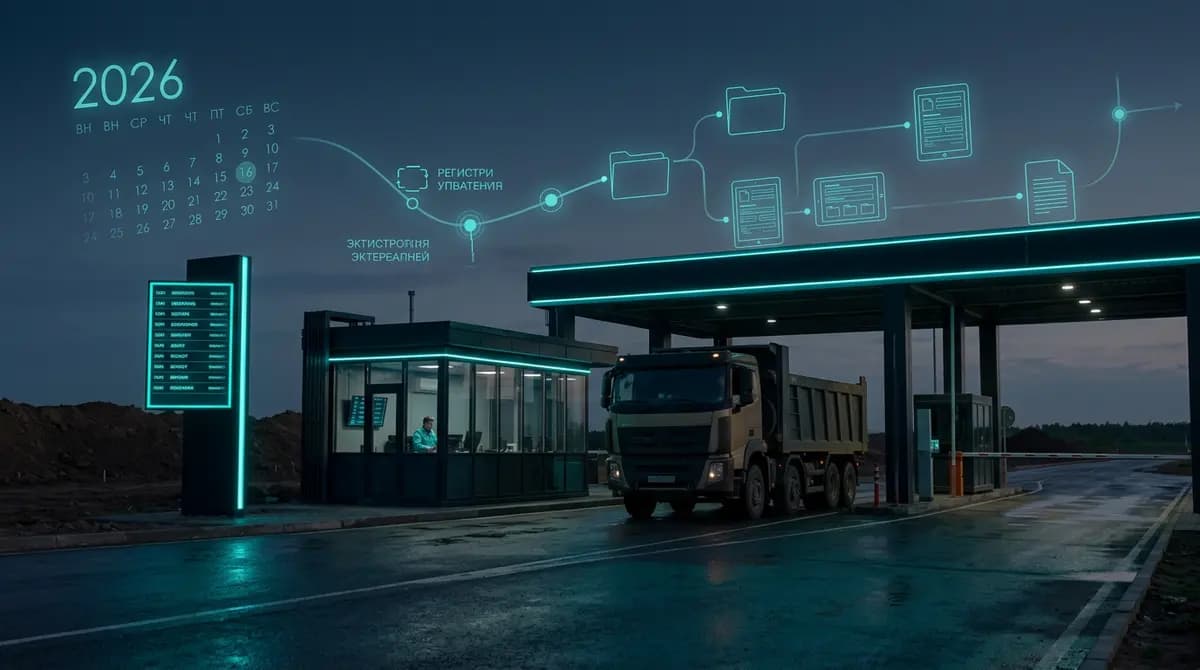
The freight forwarders register makes trip proof urgent specifically for the contractor, because it hits its segment earlier and more pointedly than the general EPD reform. Inclusion in the freight forwarders register follows a declarative procedure with a deadline around 30 April 2026 (Federal Law No. 140-FZ of 7 June 2025) — operating without registration is restricted, and for a logistics company this is not "a practice of the future" but a condition for legal access to the market. Next comes the mandatory switch to EPD and electronic transport waybills (ETrN) from 1 September 2026 and the consolidation of data into GosLog: an electronic waybill is exactly as reliable as its source, and a volume entered by hand into an ETrN is just as vulnerable as paper. IQoko Onboard gives the contractor genuine source records for every trip — volume, route, video — which feed into the ETrN and the digital shipment passport. A full breakdown of the dates and what to prepare for them is in the logistics regulatory calendar for 2026.
How much it costs to equip a fleet with an onboard loop
The cost of equipping one truck with the IQoko Onboard onboard loop and the lead times for serial delivery are clarified based on the pilot, rather than calculated per site as with a stationary CMP. The line's known price anchor is a stationary CMP from ₽1,800,000, but the onboard loop is calculated differently: not per site, but per unit of equipment, with economics driven by fleet scale. A correct calculation for the contractor is built on comparing the equipping cost with the eliminated losses from off-the-books trips and fuel theft for a specific fleet; IQoko shows the exact model in a demonstration on the customer's real trips.
Related articles

Bulk shipment control at a quarry: which CMP configuration to choose
A selection matrix for the CMP configuration to fit a quarry: when IQoko Gate is enough, when you need Gate Pro with CV volume estimation and scale integration, and how a 60–90 day pilot turns a loss hypothesis into a confirmed ROI. From the JTBD of three decision-makers — the CEO, security, and the CFO — to configuration criteria.
10 min
Read
Stationary CMP payback: how to calculate the trip-control recovery period
A step-by-step methodology for calculating the payback of a control-and-measurement station: the payback-period formula, what to attribute to CapEx and OpEx, how to factor in trip flow and the recoverable share of losses, and why a 60–90 day pilot measures that share before purchase. It turns the 5–15% loss range into a reproducible payback model for your site.
11 min
Read
Freight Regulatory Calendar 2026-2027: GosLog, registries, mandatory EPD
A navigator calendar of carrier and quarry obligations: forwarders registry (~30 April 2026), GosLog launch (1 March 2026), mandatory EPD (1 September 2026), carriers registry (1 March 2027). For each rule — the deadline, what to do, and where TripCode provides tamper-proof primary data.
11 min
Read